BST100 Car Battery Tester – Automobile Battery Tester 12V Battery Detector with Cranking & Charging System Tests


BST100 Car Battery Tester – Automobile Battery Tester 12V Battery Detector with Cranking & Charging System Tests
BST100 Car Battery Tester for 12V Battery, Cranking and Charging Checks
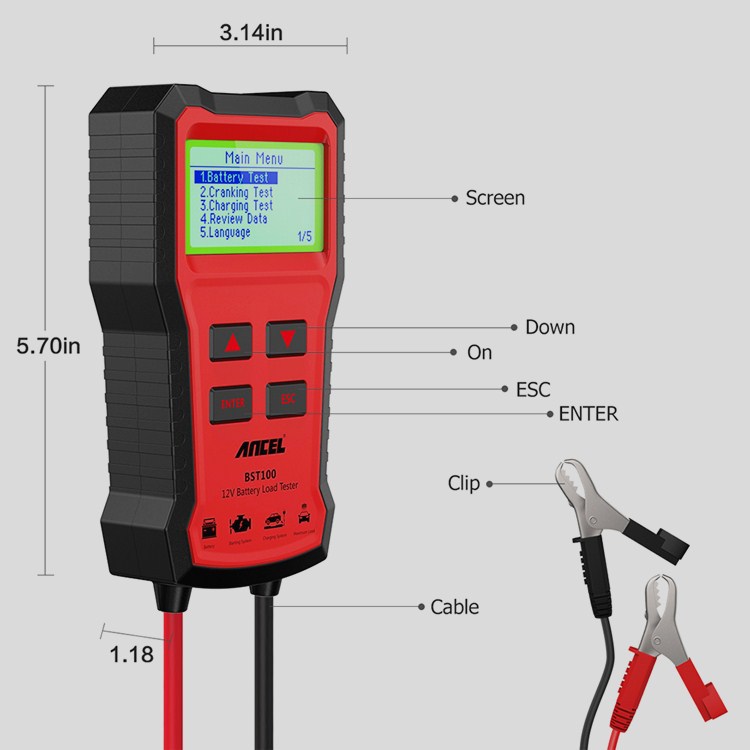
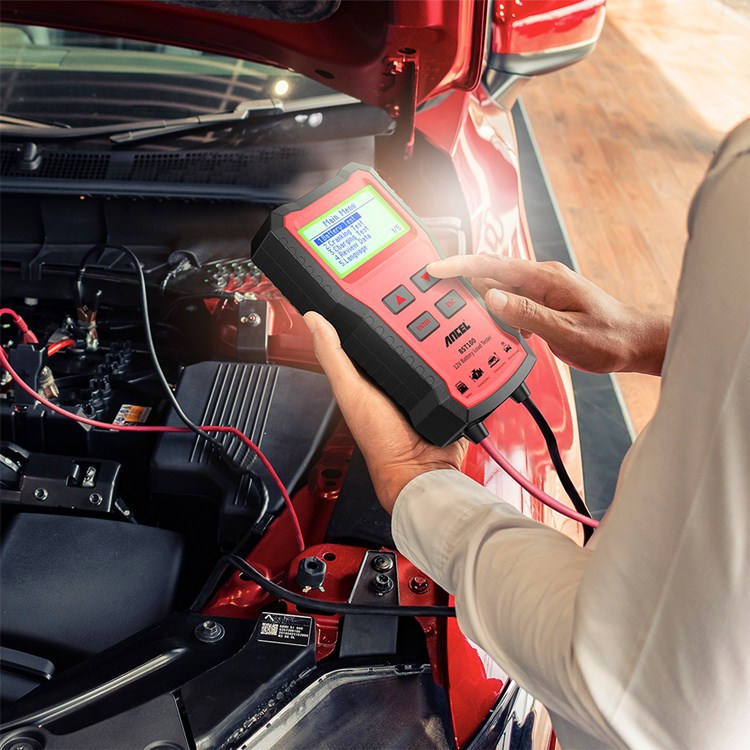
The BST100 car battery tester is a handheld meter that clips onto a vehicle battery and tells you three things: the state of the battery itself, how the starting system behaves when the engine cranks, and whether the charging system is doing its job. The unit in the photos is red and black, carries ANCEL markings and is labelled "BST100 12V Battery Load Tester". Easy Life Markets sells it for home mechanics and small workshops who would rather measure a battery than guess.
Most "dead battery" problems are a guessing game. Is the battery worn out, or just discharged? Is the alternator failing to charge it? Is the starter drawing the voltage down too far? Swapping parts until the problem goes away is the expensive way to find out. A tester gives you numbers to work from. For background on how a car battery is rated, including what cold cranking amps mean, see the automotive battery article.
What You Get
The supplier does not publish a packing list for this listing. The product photos show:
- 1 x BST100 tester with a screen and four buttons
- A fixed red and black cable ending in two battery clips
The tester in the photos has no separate power lead, and the supplier does not mention batteries for it. If you need to know whether a manual or case is in the box, ask us and we will check with the supplier.
Specifications
- Model: BST100
- Markings: The tester in the photos carries ANCEL markings
- Product type: Car battery tester, listed by the supplier as a car fault diagnosis instrument
- Voltage: Listed by the supplier as 6–12 V; the label on the unit reads "12V Battery Load Tester"
- Working temperature: -10 to 50 °C
- Menu languages: English, French, German, Russian, Spanish, Italian
- Size, as marked on the photo: 5.70 x 3.14 x 1.18 in
- Controls: Up, down, ENTER and ESC buttons
- Colour: Red
- SKU: CJQC103667701AZ
Battery Rating Standards It Accepts
Before a battery test you tell the tester which standard the battery is rated in and the figure printed on its label. The supplier's chart lists these ranges:
- CCA: 100–2000
- BCI: 100–2000
- CA: 100–2000
- MCA: 100–2000
- JIS: equivalent to 100–2000 CCA
- EN: 100–2000
- SAE: 100–2000
- IEC: 100–1400
- DIN: 100–1400
- GB: 100–1400
That covers the rating systems used on batteries sold in most parts of the world, so you can enter the number exactly as your battery label shows it.
The Main Menu, Item by Item
The screen in the photos shows five menu entries:
- Battery Test. Checks the battery against its rated figure.
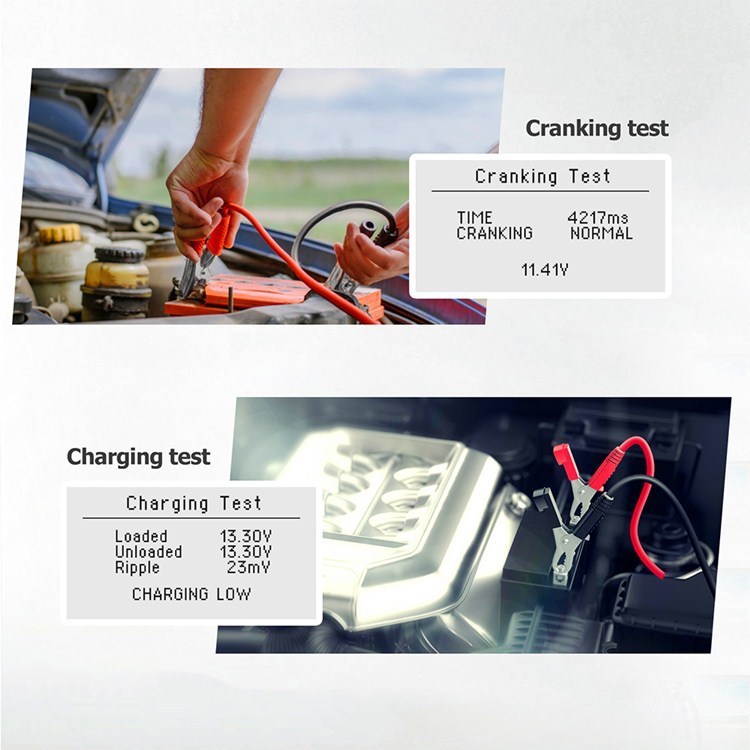
- Cranking Test. Run while you start the engine. The example screen shows the cranking time in milliseconds, a voltage reading (11.41 V in the example) and a verdict such as "NORMAL".
- Charging Test. Run with the engine going. The example screen shows loaded and unloaded voltage, ripple in millivolts and a verdict, in that example "CHARGING LOW".
- Review Data. For looking back at earlier test data.
- Language. Switches between the six menu languages.
Why This Kind of Test Is Kind to the Battery
The supplier makes two points about the test method. First, it can be used on almost all batteries, including low-capacity ones. Second, it does not harm the battery. An old-style carbon pile tester puts a heavy load across the battery for several seconds and gets hot doing it. The supplier says this tester's method avoids that kind of stress, so you can repeat a test straight away if you are not sure of the result.
How to Run a Battery Test
- Switch the engine and all electrical loads off.
- Clean the battery posts. Dirt and corrosion under the clips give false readings.
- Clip red to positive (+) and black to negative (–).
- Choose Battery Test, pick the rating standard and enter the figure from the battery label.
- Read the result, then run the cranking and charging tests if the battery itself passes.
Batteries can give off flammable gas. Work in a ventilated place, keep sparks and flames away, and wear eye protection.
Reading the Results Sensibly
- A battery that has just been driven or charged holds a surface charge. Switch the headlights on for a minute, then off, before testing.
- A deeply discharged battery can test badly and still recover. Charge it fully and test again before you replace it.
- A good battery with a low charging result points at the alternator, its belt or the wiring, not at the battery.
- A big voltage drop on the cranking test with a healthy battery points at the starter or its cables.
Who This Tester Is For
It suits anyone who looks after more than one vehicle, people buying or selling used cars, owners of cars that stand for long periods, and small garages that want a quick check at the counter. The supplier describes it as suitable for a variety of vehicle models.
Common Questions
Does it work on 6V batteries? The supplier lists the voltage as 6–12 V, but the label on the unit itself says 12V. If you need it for 6V batteries, contact us before ordering so we can confirm.
Does it need its own batteries? The supplier does not mention any. The photos show it connected only by its clips.
Can it read fault codes? No. It tests the battery, starting and charging systems. It is not an OBD code reader.
Buy the BST100 Car Battery Tester at Easy Life Markets
You can order the tester here. The current price and availability are shown on this page. Please read our return and refund policy before buying.
Related Products
Browse our batteries, tools and equipment and electrical collections.
Product Photos